03AI
How do you build an interface for a platform that makes a billion decisions a day — and make it feel effortless?
BaseModel — AI/ML Platform — Synerise · AI
01 — Problem
Synerise is a behavioral AI company whose platform makes over 12 billion automated decisions a month for enterprise clients including BNP Paribas. BaseModel is their flagship product, a behavioral foundation model that turns raw event data into real time personalization. I joined while it was still taking shape, which meant the frontend problem was organisational as much as technical. Three product teams needed to build in parallel on one codebase without stepping on each other, three surfaces needed to look and behave like one product without a style guide nobody reads, and the person on the other side of the screen was a data scientist trying to reason about a model, not admire an interface. Every early architecture decision would either compound or haunt us for years.
02 — Constraints
- Three product teams, one shared codebase — any architecture that serialised team work was a failure
- The ML pipeline is continuous and event-driven; the UI had to stay responsive as event volumes spiked unpredictably
- Design consistency across three products had to be structural — enforced by the system, not by convention
03 — Architecture
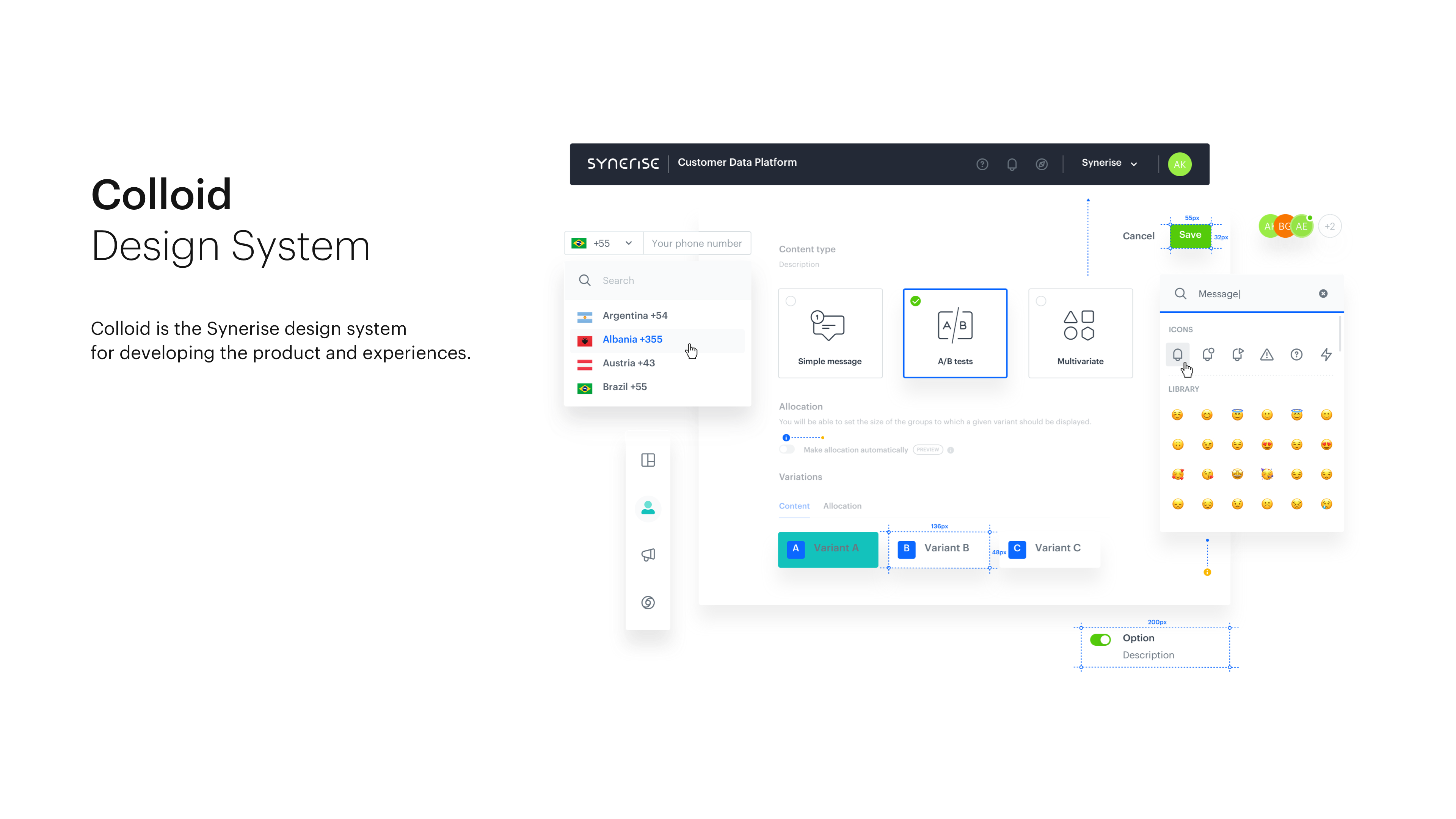
An NX monorepo gives each team a fully isolated workspace while sharing a single version of Colloid — the Storybook-first component library built to encode design decisions structurally. TanStack Query owns all server state: streaming ML outputs, polling prediction endpoints, syncing campaign data across the platform with consistent caching semantics. Teams ship features independently; Colloid makes them look like one product. Playwright E2E tests cover critical paths across all three products without duplicating setup.
04 — Solution
I helped shape the platform architecture from early design through advanced beta. We settled on an NX monorepo where each team owns an isolated workspace but everyone consumes one version of Colloid, the open source design system I co-developed, where consistency is enforced by the component API instead of by convention. I introduced TanStack Query as the standard data layer after watching three teams invent three different fetching patterns against the same ML endpoints; a typed, cacheable interface ended that quietly. Day to day I worked with architects, ML engineers, backend teams and UX designers, often translating between them: what the model could stream, what the interface could sensibly show, and what a data scientist actually needed to see to trust a prediction. The product kept evolving fast, and the architecture held.
- Senior Frontend Engineer — platform architecture
- Co-designer and contributor to Colloid open-source design system
- Frontend infrastructure across NX monorepo